Beware of Bad Companions
The Adventures of PinocchioBeware of Bad Companions is the rule that Pinocchio repeatedly hears but fails to apply: reckless friends draw him away from study and into danger, while his confidence that he can judge for himself leaves him poorly prepared for the consequences. The story makes the warning more than an adult maxim. It sets trusted counsel against the pleasure of belonging, then lets Pinocchio’s own distress reveal what his earlier bravado concealed.
The Warning and Its Pattern
Pinocchio’s vulnerability is not a lack of ability to behave well. For a time, he is attentive at school, works hard, arrives first in the morning, and stays until the end of the day. His teacher praises this conduct. The problem is that he has too many friends, including boys who care little for study or success. Good performance and poor judgment coexist: Pinocchio can meet the demands of school, yet he assumes that his social choices cannot undo that progress.
The teacher warns him repeatedly, and The Fairy with Azure Hair reinforces the same advice. Their warning is specific: these companions will eventually weaken his love of study and lead him astray. Pinocchio answers with a shrug and a gesture toward his forehead, presenting himself as too wise to be influenced. The gesture turns the rule’s central danger into a visible contradiction. He treats confidence as proof of immunity, although the very need for repeated warnings suggests that those who care for him see a risk he refuses to recognize.
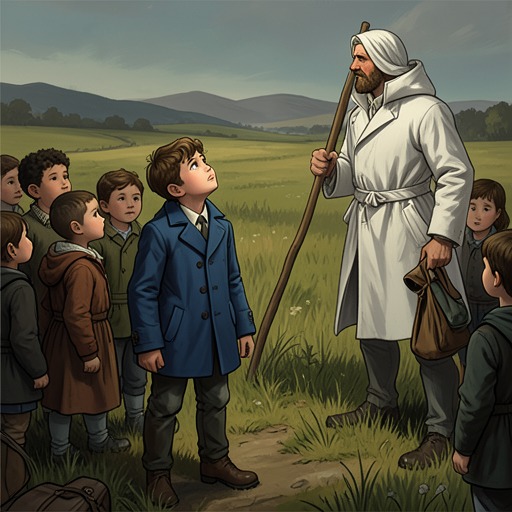
That refusal belongs to a larger pattern. When Pinocchio sets out after disregarding the advice of the Talking Cricket, he privately complains that everyone scolds, advises, and warns boys, as if everyone were trying to act as a parent. He briefly entertains the possibility that ignoring the Talking Cricket may bring misfortune, but quickly dismisses the danger ahead as a story invented by parents to frighten children who leave home at night. His imagined ability to confront or outrun danger substitutes for judgment. The bad-companion warning therefore sits within a broader habit: Pinocchio hears counsel, recognizes that trouble may follow, and then trusts his own bravado instead.
The Schoolmate’s Injury
The consequence becomes immediate when Pinocchio is left beside his injured schoolmate. The other boys flee at the sight of the pale, motionless child; Pinocchio stays. He runs to the sea, wets his handkerchief, and uses it to bathe the boy’s head. Sobbing, he calls to him and protests that he did not strike him. At the same time, Pinocchio’s distress turns inward: he fears going home, imagines hiding, and wishes he had gone to school rather than listened to the boys.
That self-reproach gives the rule its sharpest form. Pinocchio recalls that both the teacher and his mother had warned him about bad company. He describes himself as stubborn and proud: he listens, then does as he wishes, and afterward pays for it. His response does not erase his claim that he was not the one who hit his schoolmate. Instead, it distinguishes direct action from the choice that brought him into this perilous situation. The boys’ flight leaves Pinocchio alone with the injured child and with the consequences he now recognizes as connected to his own decision.
His earlier belief that he could manage any danger has given way to fear and regret. The reversal is especially forceful because he does not need another person to explain the lesson at that moment. As he tries to revive his schoolmate, he recounts the warnings himself and names his own refusal to heed them. The advice that seemed like interference has become, in retrospect, an account of what happened.
Friendship as a Misleading Promise
Pinocchio’s later conversation with Lamp-Wick shows that the problem is not simply that he has failed to remember the warning. During a life of entertainments and parties, Lamp-Wick reminds him that he once wanted to return home to The Fairy with Azure Hair and resume studying. He claims that Pinocchio owes his present freedom from pencils, books, and school to his own advice and care. He calls this proof that only true friends count.
Pinocchio accepts the claim. He says that his happiness is all because of Lamp-Wick, despite having heard the teacher describe Lamp-Wick as a bad companion who would lead him astray. The contrast with the earlier warning is deliberate: Pinocchio can repeat the substance of the teacher’s judgment, yet now uses his apparent happiness as evidence that the judgment was wrong. He measures friendship by immediate pleasure and release from obligations, rather than by whether a companion helps him keep commitments he previously valued.
Lamp-Wick strengthens that reversal by portraying the teacher as unfair and himself as generous for forgiving him. Pinocchio responds by embracing Lamp-Wick and calling him a great soul. The exchange makes the influence especially persuasive: it arrives wrapped in affection, confidence, and a claim of loyalty. The scene does not present companionship as automatically harmful; it shows how a companion can call indulgence care and encourage Pinocchio to treat caution as hostility.
Narrative Function and Moral Force
The warning is reinforced through recurrence rather than a single lesson. The Talking Cricket’s advice, the teacher’s daily cautions, and The Fairy with Azure Hair’s repeated concern all meet the same answer: Pinocchio believes that he can decide for himself without being changed by those around him. The injured schoolmate makes that belief untenable in the moment, but Lamp-Wick’s later reassurance shows how quickly the desire for approval and amusement can restore it.
The tale’s direct address to child readers frames this pattern as advice meant to be considered beyond Pinocchio’s adventures. Yet the narrative gives the young protagonist room to misread, resist, and feel the cost, rather than leaving the rule as an abstract command. Its force comes from the distance between what Pinocchio can recite and what he chooses: he knows that trusted adults have warned him, but he prefers a companion’s flattering account of freedom. Bad company leads him astray not through a mysterious power, but through his willingness to mistake immediate pleasure for good counsel.